
What Is a Shadow Box Fence? The Good Neighbor Fence Explained for Huntsville Homeowners

what is a shadow box fence

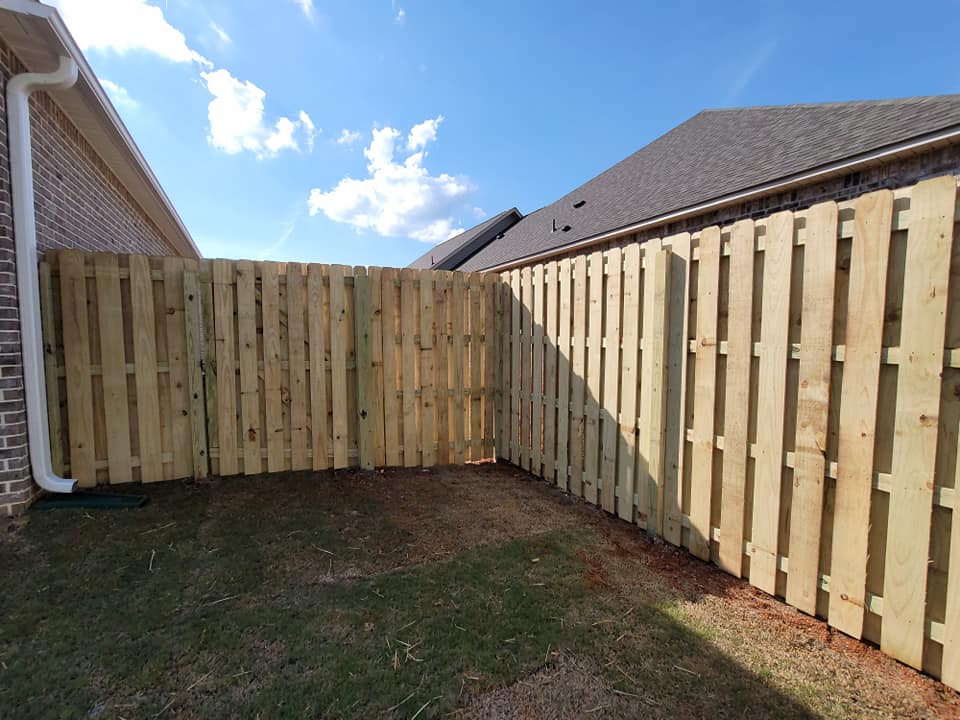
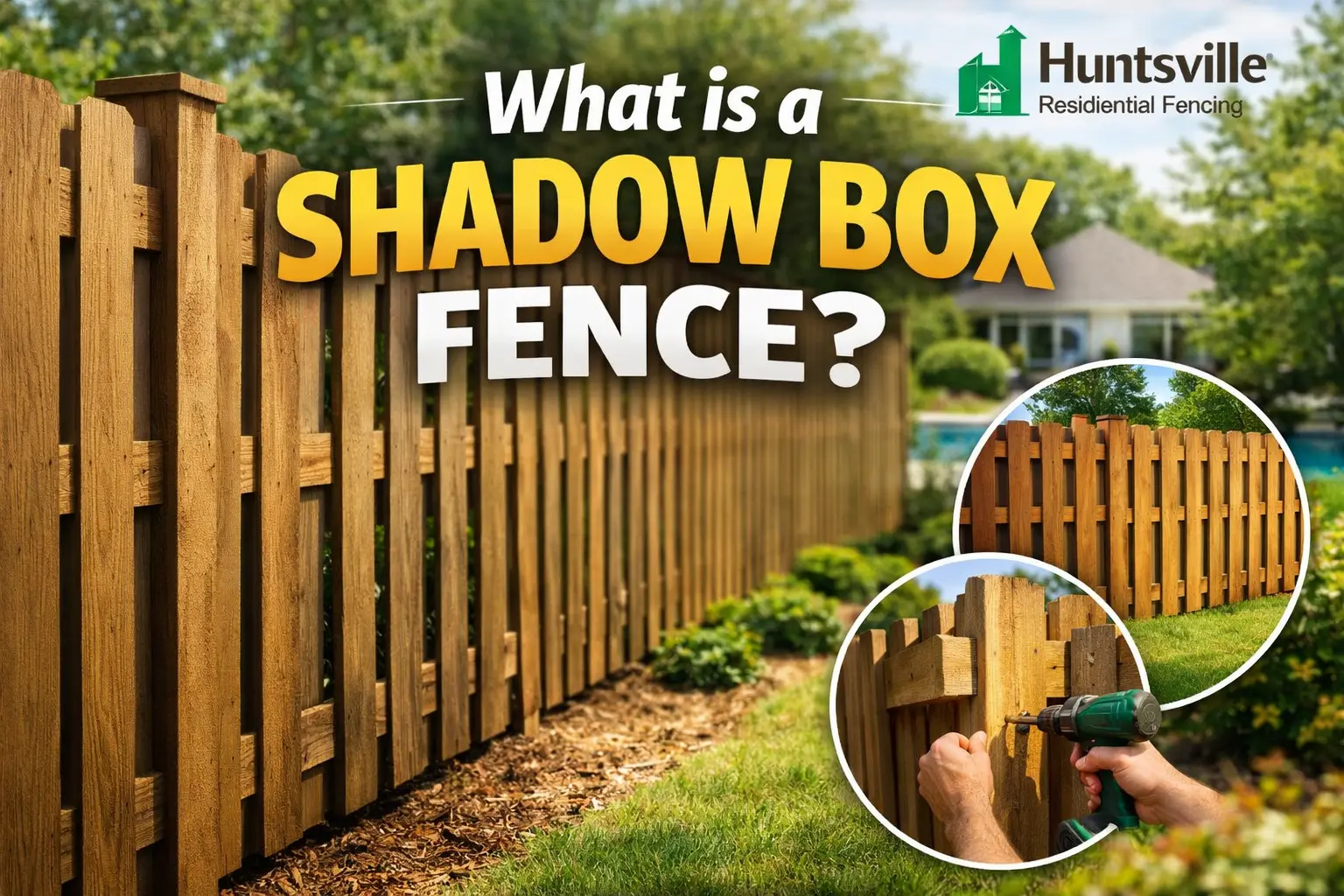
A shadow box fence is a semi-private wood fence style where vertical pickets alternate on opposite sides of the horizontal rails. One board goes on the front of the rail, the next goes on the back, creating a staggered overlap that blocks direct sightlines while still letting air and light pass through the angled gaps. Both sides of the fence look finished and identical, which is exactly why it is also called a good neighbor fence. In North Alabama, a professionally installed shadow box fence runs approximately $15 to $40 per linear foot, depending on material and project size.

We have been building shadow box fences across Huntsville, Madison, Athens, Hampton Cove, and the surrounding North Alabama communities for more than six years. It is one of the most requested styles we install, and there is a simple reason for that: it solves a problem most homeowners do not think about until after they build their first standard privacy fence. That problem is the back side. In this guide, we cover everything you need to know before you decide whether a shadow box fence is the right choice for your property.

What Makes a Shadow Box Fence Different From Other Fence Styles

Most wood fences have a front side and a back side. The front side faces outward, looks polished, and shows clean vertical boards. The back side faces your own yard and shows the horizontal rails with boards attached to them. That back-of-the-fence view is something most homeowners live with. Their neighbors do not get a choice in the matter.

A shadow box fence changes that entirely. Instead of all the pickets sitting on the same side of the rails, they alternate: one board on the front face of the rail, the next board on the back face, and so on across the entire run. That pattern means neither side of the fence has an exposed rail. Both sides show only clean vertical boards with a consistent spacing between them. The fence looks the same whether you are standing in your yard or your neighbor’s.

The staggered boards do something else worth understanding. When you stand directly in front of a shadow box fence and look straight at it, the boards block your view. The overlapping coverage makes the fence appear nearly solid. But step to the side and look at an angle, and you can see through the gaps. That is the semi-private nature of the style. You get the feeling of privacy when you are inside your yard and looking straight ahead. Someone walking past on the sidewalk gets a full view of your yard only if they stop and look sideways through the fence, which is a different kind of visual barrier than a solid fence but still a meaningful one for most residential situations.

Where the Name “Shadow Box” Actually Comes From
shadow box fence

The name comes from the visual effect the fence creates on a sunny day. Because the boards alternate front to back, the sun hits them at different depths. The boards closer to you cast shadows onto the boards behind them. That shifting shadow pattern across the length of the fence is where the name comes from. It also gives the fence a dimensional, textured look that a flat solid fence simply does not have.

How a Shadow Box Fence is Actually Built

Posts go into the ground at 6 to 8-foot intervals, set in concrete with a minimum depth of 24 inches for a 6-foot fence. Two or three horizontal rails connect the posts. Then the pickets attach to those rails, alternating sides from the first board to the last. Standard 1×6 pickets with roughly 1-inch overlap on each side is the most common configuration. The overlap is where your privacy level comes from, and we talk more about how to adjust that later.

The structure from top to bottom looks like this:

  • Post caps: seal the end grain at the top of every fence post
  • Top rail: horizontal structural support, pickets attach here from both sides
  • Pickets: vertical boards alternating front and back across the full run
  • Mid rail: optional center support for taller fences or wind-exposed runs
  • Bottom rail: horizontal structural support closest to the ground
  • Kick board: optional rot-resistant board at grade level to take soil contact

In simple words, a shadow box fence alternates boards on opposite sides of the rails so the fence looks finished from both directions. It offers semi-privacy with airflow, handles wind better than a solid fence, and is the preferred style of most North Alabama HOAs for good reason.

Why Everybody Calls It a Good Neighbor Fence

Every standard privacy fence has what contractors call a good side and a back side. The good side is the clean, finished face with vertical boards. The back side is what your neighbor sees: the horizontal rails running across the posts with boards nailed to one face. It does not look bad exactly, but it is clearly the back of a fence. If the fence sits on or near a shared property line, your neighbor is the one who spends every day looking at the raw side.

A shadow box fence gets called a good neighbor fence because it eliminates that problem. There is no back side. Both neighbors see the same finished face. Neither household is stuck with the raw view.

This is not just a courtesy point. In North Alabama, many HOA rules require that the finished side of a fence face outward toward neighboring properties. A shadow box fence satisfies that requirement automatically on both sides simultaneously. You do not have to choose which neighbor gets the good view. Everyone gets it.

We have installed shadow box fences on hundreds of shared property lines across Madison County, and the conversations with neighbors that happen after those installs are always positive. The finished-on-both-sides design tends to generate goodwill before the fence is even fully built. That matters when you are going to be living next to someone for the next decade.

Planning to share the cost of a fence with your neighbor? A shadow box fence is almost always the right call for a co-owned boundary fence. Both households get equal value from the same installation, and the finished appearance on both sides makes that conversation easier before the first post goes in.


Wood, Vinyl, or Aluminum and Why North Alabama Changes the Answer

The material you choose affects how your fence looks, how long it lasts, how much maintenance it needs, and what it costs. In North Alabama specifically, the climate narrows that decision in ways that national buying guides do not account for.

Huntsville and the surrounding communities get around 55 inches of rain per year, well above the national average. Relative humidity sits between 73% and 80% most of the year. Summers are hot and muggy. We also sit squarely in what the fencing industry calls the Termite Belt, a stretch of the Southeast where subterranean termite colonies are active all twelve months. All of that matters when you are choosing between materials that will spend the next 15 to 25 years outdoors in those exact conditions.

Material Best Thing About It Biggest Drawback Right Fit For
Wood (Cedar or Pine) Natural look, works with every home style, easiest to stain or customize Needs sealing every 2 to 3 years, more maintenance than other options Most North Alabama homeowners who want a traditional, warm appearance
Vinyl No painting, no staining, no rot ever, wipes clean easily Costs more upfront, looks more manufactured than wood Homeowners who want maximum durability with zero ongoing maintenance
Aluminum Rust-proof, lightweight, panels come preassembled for faster installs Offers less visual privacy than wood or vinyl, leans toward a commercial look Modern home styles or decorative boundary applications


What We Recommend for Most North Alabama Homes

After six years of installing shadow box fences across Huntsville and the surrounding communities, cedar or pressure-treated pine is the right answer for most residential situations here. Cedar is our first choice when the budget allows. Its natural oils make it genuinely resistant to moisture and insects without chemical treatment, which matters in our climate. Pressure-treated pine works well at a lower price point, but needs proper sealing within the first year and consistent maintenance every two to three years after that. Vinyl is the right call for homeowners who genuinely want zero maintenance and are willing to pay the higher upfront cost for it.


Why Cedar Outlasts Pine in Our Climate

We chose cedar first because it responds well to our climate. Cedar contains natural tannins and oils that fight moisture penetration and resist insect activity without any chemical treatment. In a climate that gets 55 inches of rain and sustained humidity, that natural resistance is worth paying for. A properly sealed cedar shadow box fence in North Alabama can last 15 to 20 years or more.

Pressure-treated pine is treated with chemical preservatives that also do a good job against moisture and insects, but that protection is not indefinite. The treatment slowly migrates out of the wood over the years, particularly in wet soil conditions near the post bases. For the pickets themselves, which are not in soil contact, treated pine performs well for 12 to 15 years with regular sealing. For the posts, we require UC4B-rated treated lumber on every job, regardless of what material the rest of the fence uses. That is the rating designed specifically for wood in direct soil contact, and it is not a place to cut costs.

One thing to know about new pressure-treated pine: do not stain it immediately. New treated lumber needs about six months to dry before it accepts stain evenly. Schedule your first sealing coat for the spring after a fall installation, or the fall after a spring build. Seal it too soon and it will peel.


Five Things a Shadow Box Fence Does That a Solid Fence Cannot

There are fence styles with more privacy and fence styles with more airflow. The shadow box fence earns its popularity by being the only style that handles both at a reasonable price while also looking good from two directions. That combination is why it keeps coming up in conversations with North Alabama homeowners.

1. Wind Goes Through It Instead of Pushing It Over

A solid privacy fence acts like a sail in a strong storm. Wind hits the flat surface of the boards, pressure builds against the fence, and that load transfers straight into the posts. In a bad enough storm, the posts lose. If you have ever seen a solid wood fence blown over in sections after a summer thunderstorm in Huntsville, that is exactly what happened.

A shadow box fence works differently. The gaps between the alternating boards let wind pass through rather than catching it. That reduces the total wind load on the fence significantly. Research from the Insurance Institute for Business and Home Safety found that fences with gaps between boards can reduce wind loads by up to 30% compared to solid barriers. That number holds up with what we see in the field. Shadow box fences come through North Alabama storms in noticeably better shape than solid privacy fences of the same height and post depth.

2. The Privacy Holds Up for the Way People Actually Use Their Yards

Most homeowners want privacy from neighbors who are moving around their own yards, going about their day, not from people who stop at the fence line and peer through at an angle. A shadow box fence delivers exactly that. Standing straight in front of it, you cannot see through it. The alternating boards overlap in a way that blocks the direct sightline completely. You feel enclosed in your yard in the way that matters.

The angle of visibility is a real limitation if someone is determined to look through your fence from the side. If that level of privacy matters to you, a board-on-board fence with full overlap is the right answer. But for the vast majority of residential backyards in North Alabama, a shadow box fence provides all the privacy the homeowner actually needs.

If you want to push the shadow box design closer to fully private, we can increase the board overlap from the standard 1 inch to 1.5 or 2 inches. That tighter overlap reduces the angled gaps significantly while preserving the airflow and the two-sided finish.

3. Your Backyard Gets Airflow That a Solid Fence Would Cut Off

This benefit gets underappreciated until the fence is up. Huntsville summers are hot. High humidity, minimal wind movement in enclosed spaces, and direct sun on a solid fence create a wall of trapped heat that makes your backyard feel like a much smaller, hotter space than it is.

A shadow box fence lets air move through. Breezes that would otherwise stop at your fence line continue into your yard. That airflow makes a measurable difference in how comfortable your outdoor space feels on an August afternoon. Homeowners with pools notice it especially. The air circulation keeps the pool deck cooler and reduces the stagnant-air feel that a solid fence creates around water.

4. Most North Alabama HOAs Prefer It

Many homeowner’s associations in Huntsville, Madison, Hampton Cove, and the surrounding communities either prefer or specifically require that fences present a finished appearance on both sides. A shadow box fence satisfies that requirement better than any other wood privacy style because it genuinely has no unfinished side. There is no rail-back for the HOA to object to.

When we work with homeowners who need HOA approval before installation, the shadow box style clears that process more reliably and with fewer revision requests than any other wood privacy option we build. If you are in a neighborhood with active HOA oversight, this detail is worth factoring into your decision before you commit to a style.

5. More Visual Depth Than Any Other Wood Privacy Option

The alternating board pattern creates a three-dimensional quality that a flat solid fence simply cannot match. On a bright day, the staggered boards cast shadows onto each other as the sun moves across the sky. The fence changes subtly throughout the day in a way that makes it genuinely pleasant to look at from inside your yard.

That dimension also makes a shadow box fence look appropriate with a wider range of home styles than a flat solid fence does. Modern homes, traditional craftsman builds, brick ranches, and older neighborhood homes all look natural with a shadow box fence in a way that a stark solid privacy fence sometimes does not.


The Shadow Box Fence Styles We Install Most Often

Shadow box fencing is a design principle, not a single product. The alternating-board concept can be executed in several different ways depending on the look you are after and what fits your property best.

Style What It Looks Like Best Situation to Use It
Vertical Shadow Box Classic design, boards run up and down, alternating front and back of the rail Most residential backyards and shared property lines across North Alabama
Horizontal Shadow Box Boards run side to side instead of up and down, clean modern appearance Contemporary home styles, modern neighborhoods, design-forward homeowners
Dog Ear Shadow Box Vertical boards with angled top corners cut off, the most traditional residential look Classic neighborhoods, front yards, anywhere a traditional style fits best
Flat Top Shadow Box A cap board runs flat across the top of the pickets, giving a framed, finished edge Homeowners who want a polished, architectural look with the shadow box design
Tight-Overlap Shadow Box Boards overlap by 1.5 to 2 inches instead of 1 inch, nearly solid from straight on When maximum privacy matters but you still want airflow and the two-sided finish


Which Style Fits Most North Alabama Homes?

For standard residential backyards across Huntsville and Madison County, the vertical dog ear shadow box fence is the most common choice. It fits every home style from a 1970s brick ranch to a newer subdivision build, HOAs tend to approve it without pushback, and it installs efficiently without the added cost of the horizontal design.

The shadow box fence with cap is our second most requested style for homeowners who want that extra touch of craftsmanship. The cap board running across the top of the pickets gives the fence a framed, architectural quality that stands out in a positive way. If you have seen the capped wood fences we build and liked that finished look, the flat top shadow box applies the same principle.

The horizontal shadow box comes up regularly with homeowners who have newer construction homes in contemporary neighborhoods. It reads as modern without being flashy, and it pairs especially well with board-and-batten siding or homes with strong horizontal architectural lines.


Shadow Box vs Privacy Fence vs Picket Fence

These three styles cover most of what North Alabama homeowners are choosing between when a fence project starts. The table lays out the differences directly.

Shadow Box Fence Standard Privacy Fence Picket Fence
Privacy level Semi-private, no direct sightline from head-on Fully private, solid boards Mostly open, decorative only
Airflow Strong, gaps let breeze through Minimal, boards block most air Full airflow through wide gaps
Appearance Identical on both sides of the fence Finished side faces one direction only Same on both sides
Wind handling Excellent, fence lets wind pass through rather than resist it Moderate, solid board acts as a sail in strong gusts Strong, wind passes through easily
HOA acceptance Preferred by most North Alabama HOAs Accepted but the one-sided finish can cause disputes Common in front yards, not ideal for backyards
Cost range $15 to $40 per linear foot installed $12 to $35 per linear foot installed $10 to $25 per linear foot installed
Best situation Shared property lines, HOA neighborhoods, windy lots Maximum privacy, pools, high-traffic areas Front yards, decorative borders, and low-boundary needs


Which One Is Right for Your Property

A shadow box fence is the right call when you want genuine privacy in your backyard without shutting your neighbor out of a finished view. It is also the right call on any lot that sees regular wind, which covers most of North Alabama. And it is the default choice in HOA neighborhoods where the double-sided finish is expected rather than optional.

A standard solid privacy fence is the right call when maximum privacy is non-negotiable, such as a property backing to a busy road, a pool enclosure where visibility from the street matters, or a situation where the neighbor relationship is not a factor. You pay less per foot than a shadow box fence, and you get a fully solid barrier.

A picket fence belongs in front yards and decorative applications. It is not a privacy tool. It is a boundary marker and a curb appeal choice. If you are fencing your backyard and privacy is any part of the goal, a picket fence is not the right style.

Shadow Box vs Board-on-Board and Why They Are Not the Same Fence

These two fence styles get mixed up constantly, and even some fence contractors use the terms interchangeably when they should not. They are genuinely different fences with different performance profiles.

Shadow Box Fence Board-on-Board Fence
Picket placement Alternating, one board front then one board back of the rail All boards on the same side of the rail, overlapping each other
Gaps between boards Small angled gaps at either side, visible from an angle No gaps at all when boards overlap correctly
Privacy Semi-private, blocks direct views but not angled views Fully private, zero visibility from any angle
Appearance Identical finish on both sides Finished on one side, rail-back visible on the other
Wind performance Excellent, gaps reduce wind load on the fence Good, overlapping boards add mass but catch more wind
Material cost Moderate, uses more pickets than standard but less than board-on-board Higher, the overlap requires significantly more lumber
Best for Shared lines, HOA neighborhoods, airflow-sensitive lots Maximum privacy, pool enclosures, zero-sightline requirements


The Simplest Way to Think About It

A shadow box fence puts boards on opposite sides of the rail, creating gaps that allow airflow and a finished look from both directions. A board-on-board fence puts all boards on the same side of the rail in an overlapping pattern, creating zero gaps and maximum privacy but only one finished side.

The two styles are not interchangeable. If your primary concern is that your neighbor gets a finished view and your yard gets some airflow, a shadow box fence is the right answer. If your primary concern is zero visibility from any angle, board-on-board is what you want. We build both, and we will tell you honestly which one fits your situation better when we come out for the estimate.


What a Shadow Box Fence Costs in Huntsville and North Alabama

National pricing guides give you ranges pulled from labor markets with no connection to Huntsville. The numbers below come from six years of real projects across Madison County and the surrounding communities.

A 6-foot wood shadow box fence in the Huntsville area runs approximately $15 to $40 per linear foot, fully installed. The spread is wide because wood species, fence height, total project length, terrain, and add-ons like gates all move the number significantly.


Cost by Material and Project Size

Material 100 Linear Feet 150 Linear Feet 200 Linear Feet
Pressure-Treated Pine $1,500 to $2,500 $2,250 to $3,750 $3,000 to $5,000
Cedar $2,000 to $3,000 $3,000 to $4,500 $4,000 to $6,000
Vinyl $2,500 to $4,000 $3,750 to $6,000 $5,000 to $8,000
Aluminum $3,000 to $4,500 $4,500 to $6,750 $6,000 to $9,000


These figures are complete installed costs covering materials, labor, post setting, concrete, and cleanup. They are based on standard flat or gently sloped residential lots across North Alabama. Rocky soil, steep grades, significant demo of an existing fence, or unusually long post spacing requirements add to the final number.

The Things That Move Your Price Higher

Gates Add More Than You Might Expect

A single walk gate adds $200 to $500. A double drive gate runs $500 to $900 depending on width and hardware quality. Automated gate systems are a separate line item entirely. Tell us about gates upfront because they affect post sizing, footing depth, and hardware costs from the very start of the project.

Going Taller Than Six Feet Changes the Math

Standard residential shadow box fences are 6 feet tall. Going to 8 feet adds material and labor costs, typically 20% to 30% more per foot than the standard height. Check local zoning before requesting 8-foot height. In Huntsville and most of Madison County, 8-foot fences in front yards are generally not permitted, and some rear yard situations also have restrictions.

Pulling Out the Old Fence Costs Extra

If there is an existing fence to pull out, budget $3 to $6 per linear foot for demolition and disposal. On a 150-foot run, that adds $450 to $900 before the new fence goes in.

Staining and Sealing Is a Separate Line Item

Professional staining runs $1 to $3 per square foot of fence surface. On a 150-foot, 6-foot-tall fence, that is $900 to $2,700. Many homeowners handle their first seal coat themselves, which is a reasonable approach. For cedar, get sealer on the fence within 60 days of installation. For pressure-treated pine, wait the full six months before any staining.

How to Trim the Budget Without Trimming the Quality

  1.  Longer runs cost less per foot. At 200 linear feet or more, material purchasing efficiency improves and we can often tighten the per-foot price.
  2. Book in the slower season. November through February tends to mean better scheduling availability and occasionally more room on pricing.
  3. Hold off on the gate upgrade. A basic functional gate now and a decorative upgrade later is a smart way to phase the project without affecting the fence quality.
  4. Cedar pickets on treated pine posts. Treated pine posts are what we require for ground contact anyway. Using cedar only where it matters most, the pickets and rails, cuts material costs while keeping moisture protection where the fence needs it.

How We Build Every Shadow Box Fence in North Alabama

Getting a shadow box fence right requires consistency from the first post to the last picket. The alternating board pattern makes any spacing error or alignment drift immediately visible across the full fence run. This is how we do it on every project.

Step 1: Mark the Line, Call 811, and Check the HOA

We start by walking your property line with you and laying out the fence run. Where do the gates go? Does anything in the yard create an obstacle for post spacing? Are there any slope changes we need to address with a stepped or racked fence design?

We call 811 on every project before any digging starts. It is free, it is required by Alabama law before excavation, and it marks underground utilities that would otherwise be invisible. We handle this on every job without exception.

If your neighborhood has HOA rules covering fence style, height, or setback requirements, we confirm those before ordering materials. Most North Alabama HOAs approve shadow box fences without issue, but specific requirements on board orientation, post cap style, or setback from the property line vary and are worth verifying upfront.

Step 2: Set Posts Deep and Lock Them in Concrete

Post holes go a minimum of 24 inches deep for a 6-foot fence in our area. That is roughly one-third of the total post length, plus 6 inches of gravel at the bottom for drainage. Huntsville’s clay soil holds moisture against post bases for days after rain. That gravel drainage layer is not optional in our conditions.

We use UC4B-rated pressure-treated posts exclusively for any post going into the ground. That is the rating for wood in direct soil contact, and it is the minimum appropriate for our humid, clay-heavy conditions. Posts set with fast-setting concrete get 24 to 48 hours of cure time before anything attaches to them. We do not rush this step. Posts attached before the concrete sets fully are the leading cause of fence alignment problems that show up months later.

Step 3: Run the Rails at the Right Height

Top, middle, and bottom rails connect the posts at consistent heights. A 6-foot shadow box fence gets three rails on standard residential projects. We use galvanized screws throughout, not nails. In North Alabama’s humidity, nails work loose over time as the wood expands and contracts with seasonal moisture changes. Screws hold through that movement.

Bottom rail height matters more on a shadow box fence than on a solid fence because both sides of the rail are visible. We set the bottom rail at a minimum of 2 inches above grade to prevent constant moisture wicking from the soil into the board ends.

Step 4: Hang the Alternating Pickets with Consistent Spacing

This is where the shadow box design requires more attention than a standard privacy fence. Each picket has to be installed at the correct height, plumb, and with consistent spacing from the adjacent board on the opposite side of the rail. We set the overlap at the agreed measurement, typically 1 inch to 1.5 inches, and hold that number consistently across every board in the run.

Before we start hanging boards, we sight down the rail line to confirm alignment. Any drift in the top rail shows up immediately in the board pattern and cannot be corrected once the pickets are on. We check and correct alignment before the first picket goes up, not after.

Step 5: Post Caps On, Final Walk, Nothing Left Behind

Post caps go on every post top when the pickets are complete. They seal the end grain at the top of each post, which is the entry point for the slow moisture damage that eventually shortens post life. We also check that every picket is secure, every gate operates correctly, and the top line of the fence runs true across the full length.

We walk the finished fence with you before we leave. If anything is not right, we fix it before we load the truck. Then all wood scraps, concrete material, and debris come off your property. You get written care instructions for your specific wood species and a note on when to schedule the first sealing coat.


How to Keep Shadow Box Fence in Good Shape in North Alabama’s Climate

The shadow box design does have one honest maintenance note that solid privacy fences do not: the gaps between the alternating boards create more exposed surface area to seal and more small spaces where debris collects over time. It is worth knowing about before installation, not after.

What the First Twelve Months Look Like

For pressure-treated pine, hold off on staining for the first six months. New treated lumber carries moisture and chemical preservatives that prevent stain from bonding evenly if applied too soon. Plan your first coat for spring after a fall installation.

For cedar, apply penetrating oil sealer within the first 60 days while the wood is clean and fresh. Cedar that goes its first dry season without a sealer coat will check slightly as it dries, which is not structural damage but does mean the first sealing coat goes into slightly more open wood grain than you would want.

Keep soil, mulch, and vegetation clear from the fence base from day one. The bottom trim rail and the bottoms of the pickets are the first places moisture damage shows up. Anything that holds moisture against that zone accelerates the process.

The Annual Check We Tell Every Customer to Run

  1.  Walk the full fence line each spring. Look for any pickets that have shifted, cracked, or gone soft. Individual picket replacement on a shadow box fence is a simple, inexpensive repair. Catching a failing picket early keeps it that way.
  2. Test every post base with a screwdriver. Push the tip firmly against the wood at the soil line. Good treated wood will not give. If it sinks, that post is starting to fail and needs attention before the problem spreads upward into the rails.
  3. Clear debris from the gaps between the alternating boards. Leaves and organic material lodge in those spaces and hold moisture against the wood surface longer than on an open solid fence. A stiff brush or low-pressure rinse handles this easily.
  4. Check gate hinges and latches. Gate hardware takes more abuse than any other part of the fence and loosens faster than most people expect. Tighten anything that has worked loose during the annual inspection.
  5.  Look at the post base zone for termite mud tubes. A pencil-sized mud tube running up a post at the soil line is the most reliable early sign of subterranean termite activity in our area. Find it early and address it; termites in a fence post will not stay in the fence post.

When to Re-Seal and What to Use

Pressure-treated pine needs a fresh sealing coat every two to three years. Cedar can go three to five years between coats. Use a penetrating oil stain with UV inhibitors, not a film-forming paint. Film-forming products peel off exterior wood that sees weather and moisture cycling. A penetrating stain soaks into the grain, stays flexible, and does not flake.

One note specific to the shadow box design: applying stain with a brush or low-pressure sprayer is more time-consuming than on a solid fence because you need to get both sides of every board. Budget extra time or extra labor cost for this. It is not difficult work, but it takes longer than staining a same-length solid fence.


The Questions Huntsville Homeowners Ask Us Most

These come up constantly across our projects in Huntsville, Madison, Athens, and the surrounding North Alabama communities.


What is a shadow box fence?

A shadow box fence is a semi-private wood fence style where vertical pickets alternate on opposite sides of the horizontal rails, one board on the front face of the rail and the next board on the back. This staggered arrangement creates overlapping coverage that blocks direct sightlines from straight ahead while still allowing airflow and light through the angled gaps between boards. It looks finished and identical from both sides, which is why it is also called a good neighbor fence.

What is a good neighbor fence?

A good neighbor fence is another name for a shadow box fence. The name comes from the fact that the fence looks identical from both sides: there is no unfinished rail-back face for your neighbor to look at. Both the homeowner and the neighbor see clean vertical boards. This two-sided finish makes it the most common choice for fences built on or near shared property lines in North Alabama.

Is a shadow box fence actually private?

It is semi-private. Looking straight at the fence head-on, the alternating boards create complete visual coverage, and you cannot see through it. Looking at the fence from an angle, the gaps between boards become visible, and you can see into the yard. For most residential situations, this is sufficient privacy. If you need zero visibility from every angle, a board-on-board fence is the right answer instead.

What is the difference between a shadow box fence and a board-on-board fence?

A shadow box fence installs boards on opposite sides of the rails, alternating front and back. This creates small angled gaps that allow airflow and leaves the fence looking finished from both sides. A board-on-board fence installs all boards on the same side of the rails in an overlapping pattern. This creates zero gaps and complete privacy, but only one side looks finished. The two are genuinely different fences and should not be used interchangeably.

How much does a shadow box fence cost in Huntsville, AL?

In the Huntsville area and across North Alabama, a professionally installed 6-foot wood shadow box fence runs approximately $15 to $40 per linear foot, depending on wood species, project length, and site conditions. A typical 150-foot cedar shadow box fence generally falls between $3,000 and $4,500 for the full installed project. Call us at +1 256-384-3619 for a free, no-obligation quote on your specific property.

What is the best wood for a shadow box fence in Huntsville?

Cedar is our first choice for most North Alabama homeowners. Its natural oils resist moisture and insects without chemical treatment, which matters in a climate with 55 inches of annual rainfall and year-round termite activity. Pressure-treated pine is the right choice when budget is a priority. It performs well with regular sealing and maintenance. For the posts specifically, we require UC4B-rated treated lumber on every job, regardless of what material the pickets and rails use.

How tall should a shadow box fence be?

Most residential shadow box fences in North Alabama are built at 6 feet tall, which is the standard privacy height and the maximum permitted without a building permit in most Huntsville and Madison County residential zones. An 8-foot fence is possible in some rear yard situations, but requires confirming local zoning rules first. Front yard fences are typically restricted to 4 feet or less across most of our service area.

How much board overlap gives the most privacy?

Standard shadow box fences use about 1 inch of overlap between adjacent boards. Increasing that to 1.5 to 2 inches makes the fence significantly more private when viewed at an angle without losing the airflow benefit or the two-sided finish. If privacy from angled views matters to you, we can adjust the overlap before installation starts. The cost difference is minimal since it slightly increases the total picket count.

Does a shadow box fence do well in wind?

Better than a solid fence, and significantly so. The gaps between the alternating boards let wind pass through instead of catching against a solid surface. Research from the Insurance Institute for Business and Home Safety found that fences with board gaps reduce wind loads by up to 30% compared to solid barriers. That translates to fewer fallen fence sections after North Alabama thunderstorms, which is one of the practical reasons this style holds up better over time in our region.

Do I need a permit for a shadow box fence in Huntsville?

In most standard residential situations in Huntsville and Madison County, a 6-foot wood fence set back correctly from property lines does not require a building permit. Corner lots, fences over 6 feet, and certain HOA communities are exceptions. Permit fees in our area typically run $50 to $150 when required. We always confirm local requirements before any work starts on a project.

How long does a wood shadow box fence last?

A cedar shadow box fence in North Alabama, properly installed and sealed on schedule, typically lasts 15 to 20 years before needing significant board replacement. Pressure-treated pine runs 12 to 15 years with consistent maintenance. The posts, set with UC4B-treated lumber in concrete footings with gravel drainage, typically last 15 to 20 years in Huntsville-area clay soil regardless of what material the pickets and rails use.

Can I add a cap board to a shadow box fence?

Absolutely, and we build this combination regularly. A flat cap board running across the top of the pickets on a shadow box fence is called a flat top or capped shadow box style. It gives the fence a framed, architectural finish and seals the exposed end grain at the top of every picket. That end grain sealing is a real durability benefit in our rainy climate, not just a visual upgrade. It adds modest cost to the project and is worth it for homeowners who want the best-looking, longest-lasting version of the shadow box design.


Let Us Come Walk Your Property and Give You a Real Number

We have been building shadow box fences across North Alabama for more than six years. In that time, we have put up hundreds of them in Huntsville, Madison, Hampton Cove, Athens, Hartselle, Decatur, and the communities in between. We know the soil, the HOA requirements neighborhood by neighborhood, the permit process, and the specific weather this part of the state puts every fence through year after year.

When you call us, you get a straight answer from someone who has spent six years doing this work in your backyard’s actual conditions, not someone reading from a national pricing guide. We come out, walk the property, talk through what you want to accomplish, and give you a written quote with no surprises.

Why Our Customers Call Us Back Where We Work in North Alabama
  • 6+ years building fences across North Alabama
  • Licensed and insured in Alabama
  • Free written quotes, zero obligation
  • We know your HOA rules and the local permit process
  • Galvanized hardware and premium lumber on every project
  • Reachable Monday through Friday, 9 AM to 5 PM
  • Huntsville and all of Madison County
  • Madison, Hampton Cove, and surrounding areas
  • Athens and Limestone County
  • Hartselle and Morgan County
  • Decatur and the surrounding communities
  • All of North Alabama


Call +1 256-384-3619 for a Free Quote

Monday through Friday, 9 AM to 5 PM  |  No Obligation  |  North Alabama’s Local Fencing Contractor