
When to Replace Your Old Fence? A Practical Guide for Huntsville Homeowners
Quick Answer
I explain when to replace fence, common signs people miss, and when repairs waste money. Get a free inspection from a local fencing pro.
- A short answer you can use right now if you need it.
- A clear list of signs that mean replace not repair.
- Lifespans for wood, vinyl, chain link, aluminum, and composite fences.
- A quick decision guide for repair versus replace.
- What to do about neighbor or HOA issues and local Huntsville weather tips.
When should you replace a fence?
I get this question a lot, so I will start with a clear and honest answer.You should replace a fence when it is no longer safe, strong, or worth fixing. If the posts are weak, the fence leans, the boards keep breaking, or repairs do not last, replacement is usually the better choice.Here is the short answer many homeowners look for:Replace your fence when the structure fails, repairs cost too much, or the fence no longer protects your property.Below are the three main reasons I tell homeowners in Huntsville to replace a fence instead of repairing it.The fence is no longer safe or stable
If your fence leans, shakes, or feels loose when you touch it, the structure is failing. Weak posts and rails can fall during strong winds or storms. This is common in North Alabama because of rain, humidity, and changing soil.A fence that can fall is a safety risk for kids, pets, and anyone walking near it.Repairs keep coming back
Small repairs are normal. But when the same boards, posts, or gates keep failing, the fence is near the end of its life. I often see homeowners spend money year after year on fixes that only last a few months.When repairs stop lasting, replacement saves money over time.The fence no longer does its job
Your fence should protect your yard, keep pets in, and give privacy. If boards are missing, gaps are wide, or gates will not close, the fence is not doing its job anymore.At that point, replacing the fence gives better value and peace of mind.9 clear signs you need to replace your fence
I inspect fences in Huntsville all the time. Here are nine clear signs I use to decide if a fence needs full replacement. I keep each sign short so you can scan fast. I also add a quick test, and whether you can try a DIY fix or should call a pro.1. Rotting posts or rails
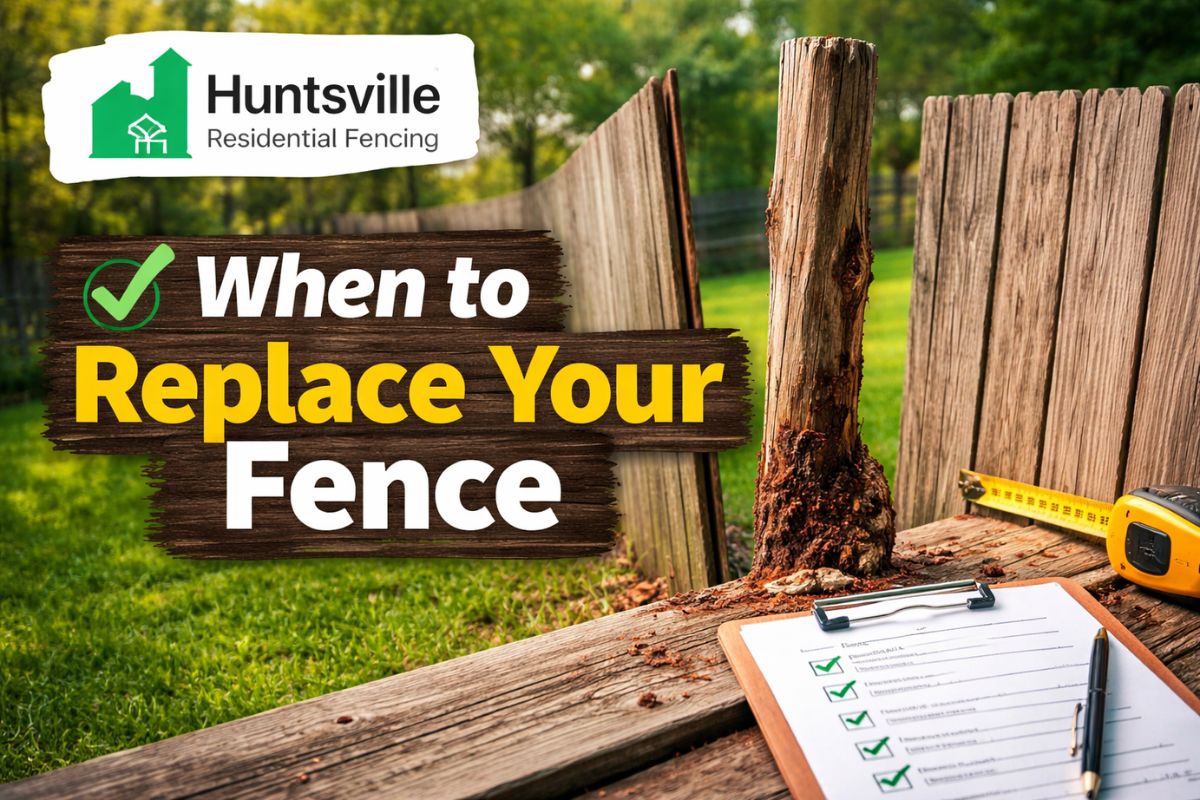
What I see: The wood at the bottom of posts or rails looks soft, crumbly, or dark. How I test: I push a screwdriver or a strong nail into the wood. If it goes in easy, the wood is rotten. DIY or pro: If only one board is soft, you might replace that board. If posts are rotten, call a pro. Rotten posts mean the fence can fall.2. Fence is leaning or slumping
What I see: Parts of the fence tilt away from the property line or sag toward the ground. How I test: I stand back and look along the fence line. If sections lean more than a few degrees, that is a problem. DIY or pro: A small lean from a loose post can sometimes be fixed. Large lean or many sections need a pro to reset posts in concrete.3. Split, warped, or missing boards
What I see: Boards split down the center, bend out of shape, or are gone. Privacy and security suffer. How I test: Walk the fence and tap boards. Listen for hollow sounds or see gaps. DIY or pro: Replacing a few boards is a simple DIY. If many boards are damaged, replace the whole panel or the whole fence.4. Loose or missing fasteners and corroded hardware
What I see: Nails, screws, or brackets are loose, missing, or rusty. Metal parts are eaten by rust. How I test: I wiggle boards and hinges with my hand. If screws fall out or metal flakes, the hardware is failing. DIY or pro: Tightening or replacing a few fasteners is a DIY. If many fasteners and posts are corroded, get a pro to inspect the structure.5. Gates that will not latch or sag
What I see: Gates drag on the ground, do not close, or the latch will not catch. How I test: I open and close the gate several times. If it hangs or drags, the post or hinges are failing. DIY or pro: A small hinge tightening or a new latch can be DIY. A sagging gate with a bad post needs a pro for safety.6. Termite or insect damage at the base of posts
What I see: Small holes, tunnels in wood, or sawdust near the post base. Workers tell me this is common in humid areas. How I test: Look for mud tubes, small holes, or piles of frass at the base of wood. DIY or pro: Call a pest control company for inspection. If termites ate the posts, replace the affected sections and treat the soil.7. Widespread mold, mildew, or persistent water damage
What I see: Large dark stains that do not wash off, warped boards from soaking, and soft wood near the ground. How I test: Try to clean a small area with water and a scrub brush. If stains and soft spots remain, damage is deeper. DIY or pro: Light mold can be cleaned. If many boards are warped or soft, plan for replacement.8. Repaired repeatedly in the same area, repair spiral
What I see: The same spot gets fixed each year and fails again. This often means the underlying structure is bad. How I test: Check repair records or ask the homeowner how often they fix that section. DIY or pro: If repairs keep failing, replace the section or the whole fence to stop wasting money.9. Code, boundary, or HOA compliance issues
What I see: A fence that is too low, too high, on the wrong side of the line, or not allowed by HOA rules. How I test: Check your property deed, survey, or HOA rules. If unclear, a surveyor can confirm the line. DIY or pro: Do not DIY legal fixes. Talk to the neighbor, check HOA rules, and hire a pro to install a correct fence if needed.How often do fences need replacing? Lifespan by material
I always tell homeowners this first. There is no single answer for how often a fence needs replacing. Fence life depends on the material, how it was installed, how well it is maintained, and the local climate.In Huntsville and North Alabama, humidity, heavy rain, storms, and termites all shorten fence life. Poor drainage and shallow posts make it even worse. Below is a simple and honest breakdown I use when talking with homeowners.Typical fence lifespan by material
Wood fencesMost wood fences last between 10 and 25 years. Pressure-treated pine is common here, but moisture and insects can reduce its life if posts are not set deep or sealed well. Rot usually starts at the post base.Vinyl fencesVinyl fences often last 20 to 30 years or more. They do not rot, but they can crack, fade, or become brittle over time, especially in strong sun or after impacts.Chain link fencesChain link fences usually last 15 to 30 years. The metal itself is strong, but rust, loose posts, and bent rails shorten its life. Poor drainage speeds up rust at ground level.Aluminum fencesAluminum fences can last 20 to 40 years. They resist rust better than steel, but sections can bend, and coatings can wear down over time.Composite fencesComposite fences often last 20 to 30 years. They resist rot and insects but can fade and loosen at joints if not installed correctly.Local note for Huntsville homeowners
Due to high humidity and frequent rainfall, wood fences in North Alabama often fail earlier than expected. I strongly recommend proper post depth, concrete setting, and pressure-treated wood rated for ground contact. These steps can significantly extend a fence’s lifespan.Fence repair vs replacement: how to decide?
I help homeowners make this choice every day. The goal is simple. Spend the least amount of money for the longest-lasting result.Here is how I decide whether a fence should be repaired or replaced.When a fence repair makes sense
A repair usually works if the problem is small and limited to one area.You can often repair a fence when:- One or two boards are damaged
- A single post is loose but still solid
- A gate hinge or latch is failing
- Damage came from a recent storm, and the rest of the fence is strong
When fence replacement is the better option
Replacement makes sense when the structure is failing, not just the surface.I recommend replacing the fence when:- More than 30 percent of the boards or posts are damaged
- Posts are rotting at ground level
- The fence leans in multiple sections
- Gates and posts are both failing
- Repairs keep failing in the same spots
A simple way to think about it
If a repair will only last a short time, replace the fence. If a repair will last several years, repair the fence.Not sure which one you need?
If you are unsure, a quick on-site inspection helps. I can tell within minutes if the structure is sound or if replacement is the smarter choice. Schedule a free 15-minute on-site inspectionDoes my neighbor have to replace his fence?
I get this question a lot. The short answer is I cannot tell you the legal side here, but I can tell you the simple steps I take when a neighbor fence is causing trouble.First, talk to your neighbor. Most fence problems begin with a friendly chat. Show the damage and explain what you think needs to be done. Many neighbors share the cost or agree on who will do the work.Second, check the property line. If the fence sits exactly on the property line, it is often considered a shared or party fence. If the fence sits fully on your neighbor’s side, then your neighbor is usually the one who must fix it. If you are not sure, a property survey or a record deed can help.Third, check your HOA rules. If you live in a neighborhood with an HOA, the rules may say who must maintain or replace a fence. HOA rules can be stricter than city rules.Fourth, do not start work that might change the boundary. If you or your neighbor want to move the fence line, get a survey first. If the disagreement gets legal, talk with a mediator or an attorney. I am not a lawyer, so I do not give legal advice. I can, however, help by doing a free boundary-impact inspection to show where the fence sits and give a written recommendation you can share with your neighbor.If the fence is unsafe and it could hurt people or property, I tell homeowners to act fast. A safe temporary fix keeps people safe while the neighbor talks are happening.Can you replace only part of a fence?
Yes, you can often replace only part of a fence. I do this every week when the damage is small and focused.When a partial replacement works:- If one panel or a few boards are damaged but the posts and most panels are solid, I replace just the bad panels.
- If one post is rotten but the rest are sound, I dig out that post and set a new one in concrete. Then I reattach the nearby panels.
- If a gate is sagging but the posts are good, I replace the gate or the hinge hardware.
- If more than about 30 percent of the fence is damaged, patching will not hold long.
- If many posts are weak or rotted at ground level, replacing parts will only delay the full replacement.
- If the fence has different materials or styles and you need a clean look, partial work can look mismatched.
How North Alabama weather affects fence longevity
The weather in North Alabama changes how long a fence will last. I see the same weather effects again and again. Knowing them helps you keep the fence longer.Humidity and rain
Huntsville has high humidity and lots of rain in some months. Wood soaks up water and stays wet near the ground. That speeds rot and makes posts fail sooner. I tell homeowners to use pressure treated wood for posts and to set posts deep in concrete.Storms and wind
Strong storms can push a bad fence over. If posts are shallow or not in concrete, a wind event will move them. After storms I check posts and rails first because those parts carry the load.Termites and insects
Termites and other insects damage wood over time. If the wood touches the soil or stays moist, insects have an easier time. I advise treating the soil and using wood rated for ground contact to reduce risk.Sun and heat
Long hot summers make some materials like vinyl brittle over many years. UV exposure can fade color and slowly weaken plastic components.Freeze and thaw are less of a worry here than in colder states. Still, wet soil that dries and moves season to season can loosen posts.What do I do to protect fences in North Alabama
- Set posts deep in concrete when the soil allows.
- Use pressure-treated wood or ground-contact-rated posts.
- Keep the bottom of wooden boards a few inches off the soil so water does not sit against the wood.
- Clean and seal wood every few years.
- Call 811 before digging to reduce the risk of hitting underground utilities.
When to call a professional fencing contractor
I want you to save money and stay safe. Here are the red flags I use that mean you should call a pro right away.Call a pro if you see any of these:- Posts are soft at the base or pull out with little force. This means the structure is failing.
- The fence leans in many places, or whole panels are loose. This is more than a single weak board.
- A gate will not latch, and the post looks cracked or rotten. Gates can be a safety risk.
- Termite damage shows obvious tunnels or soft wood at the post base. Treat pests first and then fix the fence.
- The fence is near underground utilities or large landscaping features. A pro will locate lines and plan safe post placement.
- You need a straight, solid run over uneven ground. Leveling and stepping a fence takes skill and the right tools.
- Proper post setting: We dig to the right depth and use concrete or other methods that match local soil.
- Correct post spacing and structural rail attachment for a long-lasting fence.
- Safe removal of the old fence and disposal of materials.
- Local code and HOA compliance: We can help you confirm height and setback rules. For example, the City of Huntsville does not require a permit for most residential fences, but historic districts may need approval. For specifics, call the city or Community Development.
Frequently asked questions about replacing a fence
u003cbu003eHow do I know if my fence is structurally unsafe?u003c/bu003e
u003cspan style=u0022font-weight: 400;u0022u003eIf posts wobble, panels lean, gates will not latch, or if you see soft wood at the post base, the fence may be structurally unsafe. If you are worried, ask a pro to inspect. A quick check can show if the posts are sound.u003c/spanu003e
u003cbu003eIs it cheaper to repair or replace a fence?u003c/bu003e
u003cspan style=u0022font-weight: 400;u0022u003eSmall repairs cost less in the short term. If only a few boards or one post is damaged, repair them. If more than about 30 percent of boards or posts fail, replacement is cheaper over time. Repeated repairs add up fast.u003c/spanu003e
u003cbu003eDo I need a permit to replace a fence in Huntsville?u003c/bu003e
u003cspan style=u0022font-weight: 400;u0022u003eMost of the time, you do not need a building permit for a residential fence in the City of Huntsville. If your property is in a Huntsville Historic District, you may need approval from the Historic Preservation Commission. Check with Huntsville Community Development for your situation.u003c/spanu003e
u003cbu003eHow long does fence replacement take?u003c/bu003e
u003cspan style=u0022font-weight: 400;u0022u003eSmall jobs like a few panels or a gate, can take a day or two. A full fence line for a typical yard often takes two to five days, depending on length, gates, and the ground. If there is demolition, rotten posts to remove, or heavy grading, it can take longer.u003c/spanu003eu003cspan style=u0022font-weight: 400;u0022u003enu003c/spanu003e